An online shop has two connected sides: helping a customer choose and completing what was purchased. Planning the second side early prevents the storefront from promising a process that the business has not yet defined.
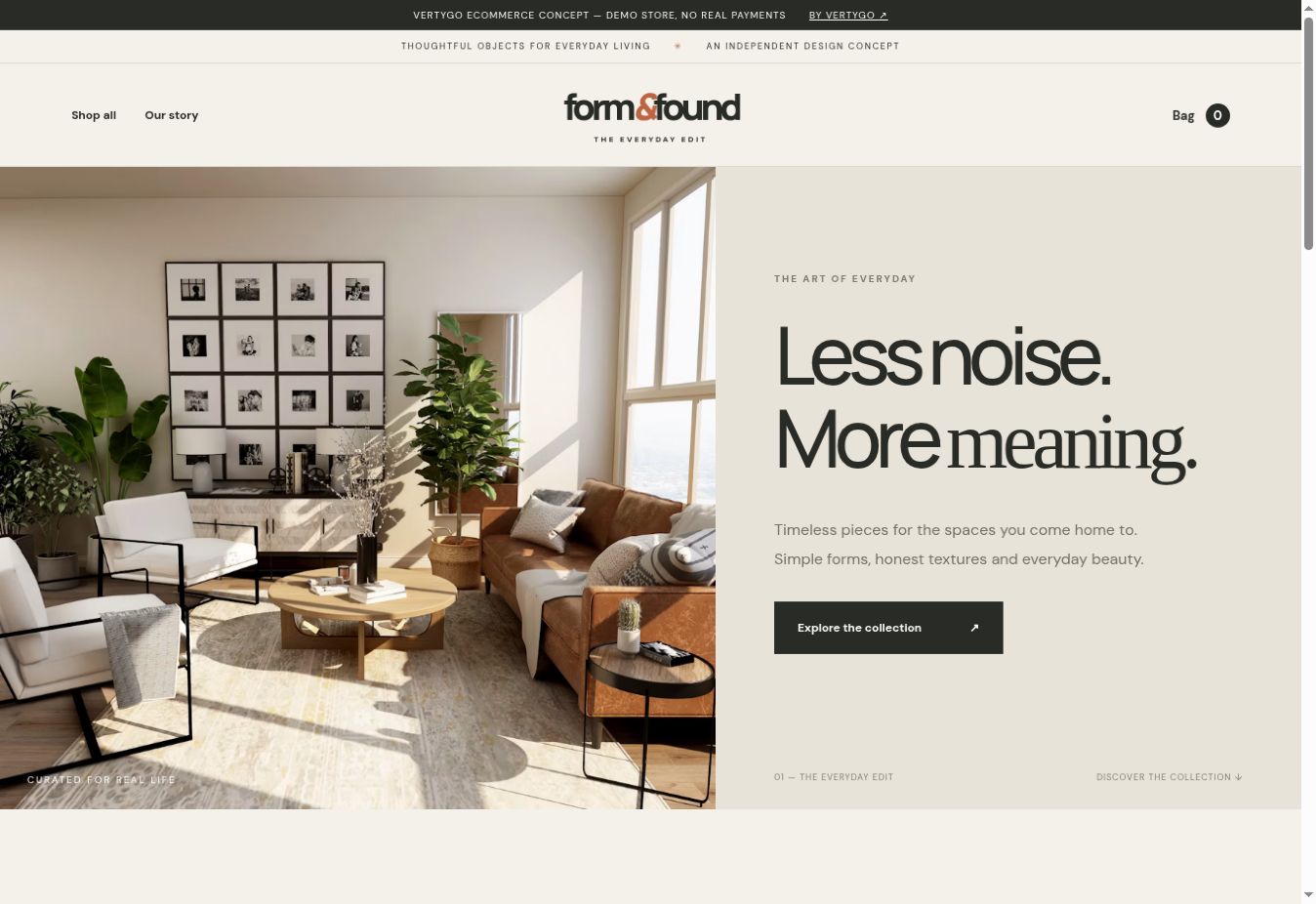
Vertygo's Form & Found demo shows a fictional homeware storefront. It does not process real payments or orders. The visual example is a starting point for discussing a shop, not proof that its payment and fulfilment requirements are already solved.
Start with what you are selling
Create a product record that a customer can understand without a conversation. For a physical item, include accurate dimensions, materials, variations, photographs and the price. For a digital item or paid service, define what will be supplied and how the customer receives it.
Do not assume that every item follows the same delivery route. A posted parcel, a download and an individually prepared service may need different information and confirmation messages.
Map a single order from start to finish
Write the steps for one ordinary order:
- The customer chooses the correct product or variation.
- They see the price and applicable delivery information.
- They provide the details needed for the order.
- Payment succeeds or fails, with a clear outcome.
- The business receives the information needed to fulfil it.
- The customer receives confirmation and any agreed updates.
Now repeat the exercise for an unavailable item, an interrupted payment and a refund. These cases help define the work before the shop is built.
Give product photographs context
Use images that match the item being sold. Keep the crop and presentation consistent enough for customers to compare products, while retaining the detail that matters. Do not hide important size or material information behind attractive styling.
Write alternative text that describes the image. Google's image guidance explains how surrounding content and image descriptions help interpretation; repeated keywords are not a substitute for useful product information.
Test the complete flow before launch
Use the payment provider's test environment for implementation checks. Confirm that the correct order is recorded, that duplicate notifications do not create duplicate fulfilment, and that the customer can tell what happens next.
The final launch checklist should cover the business's actual delivery, stock, customer-service and policy arrangements. A design review alone cannot confirm those processes.
Decide how the shop will grow
Agree how products are added, images are updated and orders are managed. A manageable first catalogue with a tested order journey gives you a clearer base for adding more later.